

Energy Efficient Laundry Appliance Hacks
The colder months are rapidly approaching and as we desperately cling on to the last few dregs of summer, we’re probably all dreading this winter even more than usual.
The cost of living crisis will really take hold as the temperatures drop, particularly in light of the increased energy prices, and families will be looking for every opportunity to save money.
As well as the heating being switched on, the onset of winter also spells the end of the outdoor clothes line and marks the return of the trusty tumble dryer.
Laundry appliances haven’t always been renowned for their energy efficiency, but the good news is there are ways you can save money – even the smallest of lifestyle changes can add up to significant savings.
In this article we’re going to give you some top tips and handy hacks for making sure your washing machine and tumble dryer are operating as efficiently as possible, while ensuring your clothes are fresh and clean. Please try these before you resort to turning your underwear inside out for another wear!
Washing Machine Tips
Time
Time is money as they say, and the same is true for washing your clothes. Did you know that the cost of your energy could vary depending on the time of day?
Typically, washing between 4pm and 7pm is thought to be the priciest time to do your washing and therefore likely to have the biggest impact on your energy bills.
This is because using electricity at times of peak demand could result in a higher cost, depending on your tariff. By a similar token, energy prices are often at their lowest overnight, between around 10pm and 5am, when demand is lower.
While you mustn’t run your appliances when you’re in bed due to the risk of fire, if you’re an early riser or a night owl, you could capitalise on this by sticking a quick load on.
Many of the washing machines available for sale on our website come with programmable start times, so if you’re likely to forget, you can set a machine to come on at 10pm or early in the morning.
Temperature
It’s quite widely known and understood now that washing at lower temperatures can save energy and therefore reduce cost, but people may not always realise the extent of the savings.
To put this into perspective, washing at 30 degrees instead of anything in the 40 to 60-degree temperature bracket, can actually halve the energy usage, so it’s definitely worth knocking it down those few degrees!
Probably less known is that it can be more cost-effective to wash things like bedding and sports clothes on a short hot wash. This way you’re blasting out all the grime and bacteria in one effective and efficient wash.
Fortunately, energy efficiency is now increasingly being built into modern appliances in a bid to protect the environment, which has the added benefit of protecting the bank balance.
They often also now include an eco setting so you can wash even more efficiently. It’s worth using this setting as often as possible if your machine has one.
Load size
When it comes to the size of your load, there’s a fine balance between making it worth putting the washing machine on and not overloading it. A good rule of thumb (or hand) is to make sure you can still get your hand in and touch the top of the drum after putting your laundry in.
Make sure everything is well separated and placed inside loosely, doing up buttons and so on to avoid smaller items getting caught up in bigger ones.
You don’t want to work your machine too hard and you also don’t want to find that half of your clothes aren’t clean because they’ve been packed in too tightly together.
If you find that you’re regularly wanting to overload your machine, or it seems to always be on, then it might be worth looking at a washing machine with a bigger drum that you can then use more efficiently.
For more information, check out our guide to what size washing machine you need.
While this would involve the initial investment, you should see resulting savings over time. Remember, with ElectroCare you can spread the cost of your appliance into manageable payments.

Maintain your washing machine
It’s a bit of a chore (and one that we don’t often have time for), but keeping your washing machine in good working order is vital. This can help make sure it lasts longer and runs as efficiently as possible.
Little tasks like making sure any drawers and filters are regularly cleaned and keeping on top of limescale build-up, can go a long way.
You can do this by running your machine on a hot cycle with a limescale removing product as per individual product instructions.
Or, if you prefer a homemade solution, pour two cups of white vinegar into the detergent drawer and run it on the hottest cycle. When it’s finished, pour half a cup of baking soda directly into the drum and run the machine again on another hot cycle. Doing this every three months should help keep your machine clean, limescale free and in good working order.
If you don’t look after your machine you’ll find that clothes aren’t coming out as clean and you might end up washing clothes more than once. In the worst case scenarios you could find yourself having to pay for costly repairs or a replacement appliance.
Pick your programme
As we mentioned above, many modern washing machines have a variety of different wash cycles, designed to give you clean clothes with the least power consumption. This could be anything from a quick rinse, to an intensive hot wash.
For example, a load of lightly used T-shirts wouldn’t need the same treatment as heavily soiled rugby clothes or construction site workwear. Washing your woollen jumpers this winter is very different to a load of swimwear and summer dresses.
It’s therefore worth paying attention to the modes and selecting the appropriate one for the job at hand.
You can check out our wide range of washing machines, and explore some of the programme variety available, on our website.
Tumble Dryer Tips
Just as there are tips for improving the energy consumption of your washing machine, the same is true for your tumble dryer, which could be especially handy if you’re expecting the radiators to be on less this winter!
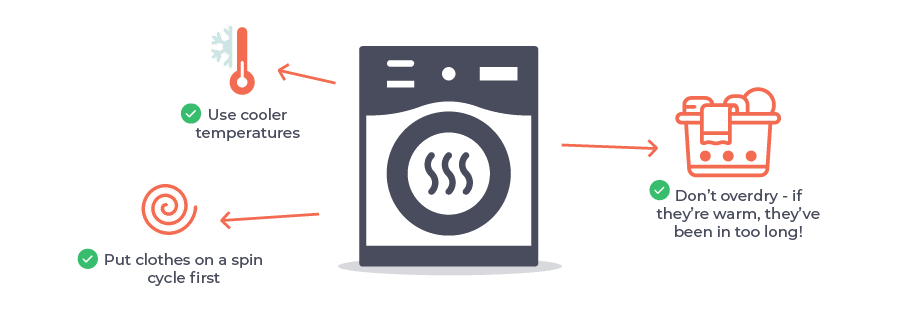
Before we get into these fab energy-saving tips, the first step is to always make sure clothes have been spun in your washing machine before they go in the tumble dryer. Most washing machine programmes will end on a spin anyway, but anything you’ve hand-washed, for example, needs to be drained of excess water, otherwise your tumble dryer will be facing a long struggle to get your clothes dry.
Time
The same as with your washing machine, time is also a factor for your tumble dryer. Have a look at your energy tariff and if it varies depending on the time of day, then consider drying your clothes accordingly to help keep costs down.
As mentioned above, you can also reduce the amount of time your tumble dryer is on by making sure clothes have been through a spin cycle in the washing machine first.
Make sure not to overdry your clothes as well. Did you know that if your clothes come out warm to the touch then they’ve been in for too long? Start with shorter stints, then check if the clothes are dry.
Temperature
Cooler temperatures are best for energy efficiency. While it might take your clothes a bit longer to dry, this method uses less power. It just means you’ll have to plan what you’re wearing in advance, rather than those last-minute one-hour turnarounds for your best work shirt.
Dryer balls!
If you’ve never used a dryer ball before, prepare to be amazed! This is our favourite energy-saving tumble dryer tip. You can get special wool or rubber balls to put in your dryer that help separate your clothes. This in turn improves airflow around the drum and helps clothes dry quicker so your dryer doesn’t need to be on for as long.
Tumble dryer maintenance
Just like all appliances, your tumble dryer needs a little TLC to work as efficiently and effectively as possible.
The big one here of course being the lint filter – it’s surprising just how quickly these fill up. A filter blocked with fluff will stop the circulation of air in your dryer and will mean it has to work harder, resulting in higher energy bills.
Not only that, but a clogged lint filter could actually pose a fire risk, so it’s definitely worth giving it a quick clean out after every use.
Detangling
Your clothes will take a lot longer to dry if they are all tangled up – just picture those twisted up shirt sleeves, the dress belt that somehow winds up firmly entwined around a jumper, or how the entire load will mysteriously worm its way into the deepest corners of a duvet cover.
Make sure everything is separated out. Small measures such as doing up buttons on the duvet cover and taking fabric belts out of their loops before drying, can help achieve a more even and quicker drying cycle.
To get a better feel for different models and features, check out our range of tumble dryers on our website.
Conclusion
We’re all going to be feeling the pinch this winter and looking for anything at all we can do to save money.
There are many small changes you can make in your laundry habits that can improve the efficiency of your appliances and go some way towards at least softening the anticipated rise in energy prices.
Sometimes though, there’s just no avoiding it and it’s time for a new washing machine or tumble dryer – particularly if you have an older model that is more costly to run.
Modern appliances are usually more energy efficient as standard and have a variety of programmes and features that help reduce power consumption and boost performance, including timers and eco-modes.
Find out how to save money with energy efficient appliances here. ElectroCare has a wide range of laundry appliances in stock and can even offer a variety of repayment options to help you ‘Plug in now, and pay later’, so you can start reaping the rewards of a more efficient appliance now, but spread the payments into more manageable chunks.

